


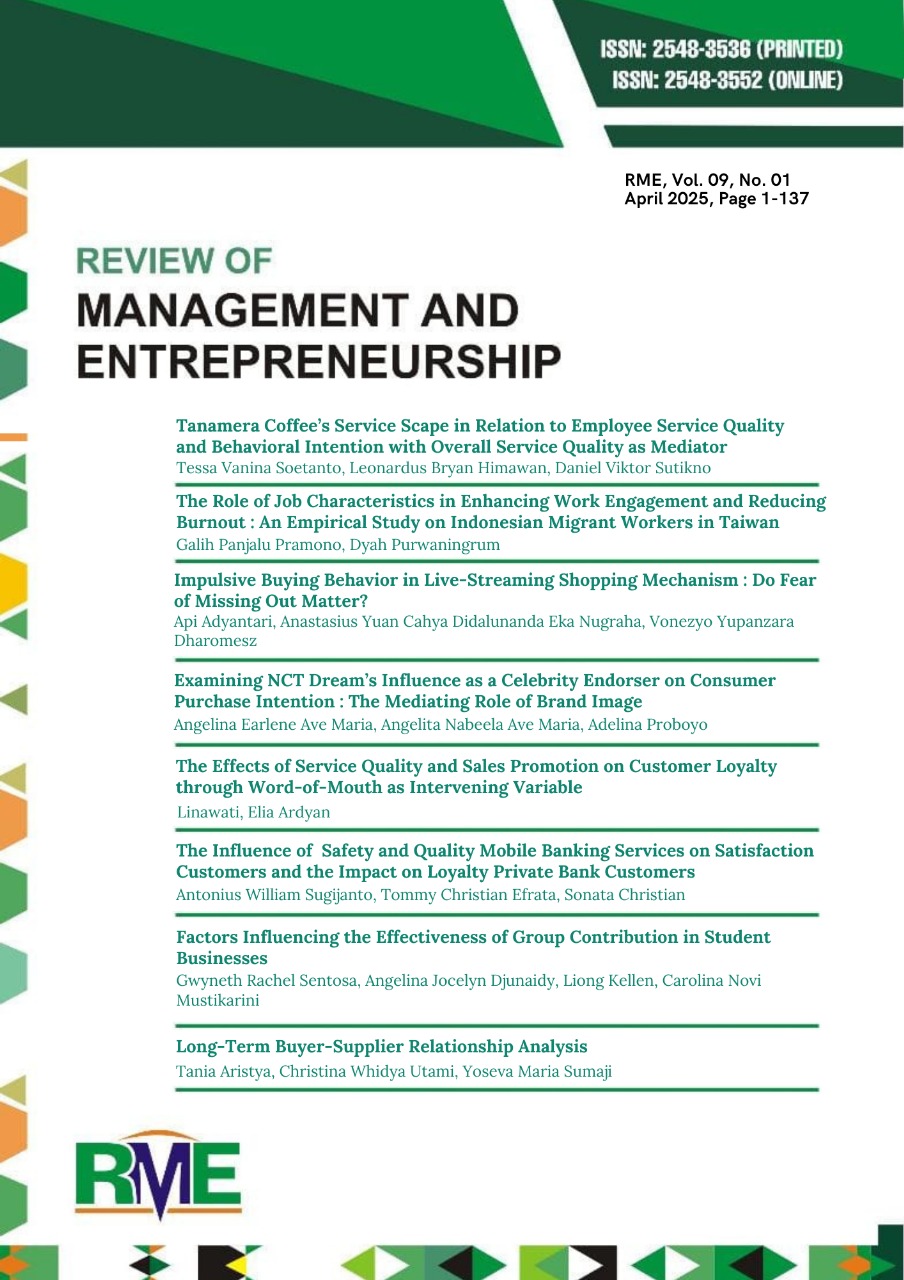
Long-Term Buyer-Supplier Relationship Analysis
Article Sidebar
Main Article Content
Abstract
This study discusses the factors contributing to the long-term relationship between a business and its suppliers. The problem faced by the company is the unfulfilled realization of the fulfillment of the copra raw material. The competition among copra business players and the potential suppliers choosing to sell to competitors causes this problem. This research aims to determine the factors contributing to the sustainability of the relationship between the company and its suppliers. The method used in this study is a quantitative method with an exploratory factor analysis approach using the SPSS analysis tool. The population in this study consists of 45 company suppliers scattered in North Maluku and East Nusa Tenggara. The sampling technique used is saturated sampling, involving all 45 respondents in the population. The data collection method in this research uses a questionnaire with a Likert scale. The results of the factor analysis revealed the formation of five new factors, which are simplifications of the fifteen research variables. These factors are interpersonal Relationships, satisfactory performance, trusted practices, loyalty, and communication synchronization.
Article Details

This work is licensed under a Creative Commons Attribution 4.0 International License.
References
Agarwal, U. A., & Narayana, S. A. (2020). Impact of relational communication on buyer–supplier relationship satisfaction: role of trust and commitment. Benchmarking: An International Journal.
Argyres, N., Bercovitz, J., & Zanarone, G. (2019). The role of relationship scope in sustaining relational contracts in interfirm networks. Strategic Management Journal, 41(2), 222–245.
Bag, S. (2018). Buyer-supplier relationship and trust theory in innovative green procurement practices. International Journal of Logistics Systems and Management, 30(1), 113–137.
Barella, Y., Fergina, A., Mustami, M. K., Rahman, U., & Alajaili, H. M. A. (2024). Quantitative methods in scientific research. Jurnal Pendidikan Sosiologi dan Humaniora, 15(1), 281.
Budiman, C., Massie, J., & Wullur, M. (2015). Identifikasi desain jaringan manajemen rantai pasok kopra di Kota Manado (studi di Kelurahan Bengkol dan Kelurahan Tongkaina). Jurnal EMBA: Jurnal Riset Ekonomi, Manajemen, Bisnis dan Akuntansi, 3(2).
Dewi, S., & Xia, L. (2022). Analysis of trade specialization and competitiveness of Indonesian coconut oil in the international market (2010-2020). Open Journal of Business and Management, 10(1), 245–262.
Doney, P. M., & Cannon, J. P. (1997). An examination of the nature of trust in buyer–seller relationships. Journal of Marketing, 61(2), 35–51.
Fabrigar, L. R., & Wegener, D. T. (2012). Exploratory factor analysis. Oxford University Press.
FAO. (2020). Countries by commodity. Food and Agriculture Organization of the United Nations.
Ferro, C., Padin, C., Svensson, G., & Payan, J. (2016). Trust and commitment as mediators between economic and non-economic satisfaction in manufacturer-supplier relationships. Journal of Business & Industrial Marketing, 31(1), 13–23.
Gadde, L.-E., & Wynstra, F. (2017). Purchasing and supply management: on strategic roles and supplier interfaces. No Business is an Island, 67–86.
Glavee-Geo, R. (2019). Does supplier development lead to supplier satisfaction and relationship continuation?. Journal of Purchasing and Supply Management, 25(3), 100537.
Hanafi, A. N., Widjaja, F. N., & Setyawan, A. B. (2019). Analisis hubungan antara trust, commitment, economic satisfaction, dan non-economic satisfaction dalam buyer-supplier relationship di Surabaya. Calyptra, 7(2), 2180–2198.
Handfield, R. B., & Bechtel, C. (2002). The role of trust and relationship structure in improving supply chain responsiveness. Industrial Marketing Management, 31(4), 367–382.
Hasan, K. M. (2024). Quantitative methods in social science research: Systematic review of content analysis, survey and experiment methodologies. Survey and Experiment Methodologies.
Herlina, V. (2019). Panduan praktis mengolah data kuesioner menggunakan SPSS. Elex Media Komputindo.
Hestina, J., Purba, H. J., Yusuf, E. S., Dabukke, F. B. M., Azhari, D., & Darwis, V. (2022). Industri kelapa indonesia: kinerja dan perspektif pengembangan menuju peningkatan nilai tambah dan daya saing. Forum Penelitian Agro Ekonomi, 40(1), 55-69).
Hinds, P. J., & Weisband, S. P. (2003). Knowledge sharing and shared understanding in virtual teams. Virtual teams that work: Creating conditions for virtual team effectiveness, 21-36.
Huda, M., Aminuddin, A., & Wusko, U. (2018). Pengaruh information sharing, longterm relationship, cooperation, integration dalam supply chain management terhadap kinerja perusahaan (survei pada ikm pengolahan makanan di kabupaten pasuruan). 10,147-162.
Jamaludin, M. (2021). Pengaruh komunikasi bisnis dan strategi aliansi terhadap kinerja manajemen rantai pasok pada PT. “xxx” Bandung. Linimasa: Jurnal Ilmu Komunikasi, 4(2), 161-173.
Jasin, H., Mujiatun, S., Rambe, M. F., & Siregar, R. B. (2021). Apakah kepercayaan memediasi pengaruh reputasi bank dan religiusitas terhadap purchase intention?. Jurnal Ilmiah Manajemen dan Bisnis, 22(1), 86-102.
Kang, J., & Hustvedt, G. (2014). Building trust between consumers and corporations: the role of consumer perceptions of transparency and social responsibility. Journal of Business Ethics, 125, 253-265.
Kotabe, M., Martin, X., & Domoto, H. (2003). Gaining from vertical partnerships: knowledge transfer, relationship duration, and supplier performance improvement in the US and Japanese automotive industries. Strategic Management Journal, 24(4), 293-316.
Lanani, K. (2013). Belajar berkomunikasi dan komunikasi untuk belajar dalam pembelajaran matematika. Infinity Journal, 2(1), 13–25.
Liu, Y., Li, Y., Shi, L. H., & Liu, T. (2017). Knowledge transfer in buyer-supplier relationships: the role of transactional and relational governance mechanisms. Journal of Business Research, 78(1), 285-293.
Naik, A., C. Madhusudhan, M., Raghavarao, K. S. M. S., & Subba, D. (2015). Downstream processing for production of value-added products from coconut. Current Biochemical Engineering, 2(2), 168-180.
Pahurkar, R. N., Sangvikar, B. V., Khadke, K., & Kolte, A. (2020). An exploratory study of important dimensions in strengthening buyer-supplier relationship. International Journal on Emerging Technologies, 11(2), 803-810.
Pangestu, A. D., Dharmawan, B., & Satriani, R. (2022). Daya saing ekspor minyak kelapa Indonesia di pasar internasional. Jurnal Ekonomi Pertanian dan Agribisnis, 6(1), 51-61.
Panggaresta, M. J., & Alhazami, L. (2022). Pengaruh information sharing dan long term relationship terhadap kinerja operasional pada outlet chigo. Jurnal Ekonomi dan Manajemen, 2(4), 189-200.
Pranata, K., Yunus, L., & Limi, M. A. (2019). Analisis komparatif pendapatan pengolah kopra hitam dengan pengolah kopra putih di Desa Horongkuli Kabupaten Kolaka. 4(1), 156-160.
Pramudita, A. P., & Dwiyanto, B. M. (2017). Faktor-faktor yang mempengaruhi kinerja hubungan pemasok dan pembeli serta dampaknya terhadap keunggulan bersaing pada bisnis skala mikro penyedia makanan dan minuman di kawasan UNDIP Tembalang.
Rahmawati, E., Nuraini, C., & Mutolib, A. (2023). Export competitiveness of Indonesian copra in international trade 2017-2021.
Rebelo, A. F., Nobre, H., & Szczygiel, N. (2019). Managing relationships with suppliers. Advances in Logistics, Operations, and Management Science, 50–69.
Rihayana, I. G., Salain, P. P. P., & Adhika, N. R. (2019). Determining factors for marketing success in endek and embroidered textile industry through the integration of entrepreneurship orientation and customer relationship marketing in marketing capabilities. Review of Management and Entrepreneurship, 2(1), 31–48.
Riwukore, J. R., Marnisah, L., Yustini, T., & Habaora, F. (2022). Display of organizational commitment from the state civil apparatus at the secretariat of the regional government of Kupang City, East Nusa Tenggara Province. Review of Management and Entrepreneurship, 6(2), 111–144.
Rungsithong, R., & Meyer, K. E. (2020). Trust and knowledge sharing in context: a study of international buyer-supplier relationships in Thailand. Industrial Marketing Management, 88(1), 112-124.
Sahari, Y., Anuar, M. S., Mohd Nor, M. Z., Abdul Ghani, N. H., & Mohd Tahir, S. (2023). Progress, trends and development of drying studies on coconut kernel products: a review. Pertanika Journal of Science and Technology, 31(5), 2621–2644.
Santoso, M. D. Y. (2021). Dukungan sosial dalam situasi pandemi Covid-19. Jurnal Litbang Sukowati: Media Penelitian dan Pengembangan, 5(1), 11-26.
Şengün, A. E., & Nazli Wasti, S. (2007). Trust, control, and risk: a test of das and teng's conceptual framework for pharmaceutical buyer-supplier relationships. Group & Organization Management, 32(4), 430-464.
Setiawan, N., Hasibuan, H. A., & Setiawan, A. (2019). Pengaruh hubungan interpersonal dan efektivitas kerja terhadap kualitas pelayanan publik (studi empiris pada kantor Basarnas Medan). Jurnal Ilmu Manajemen Methonomix, 1(2), 77-84.
Sugandini, D., & Wendry, B. (2017). Influence of quality relationship and satisfaction on loyalty: a study on suppliers in Indonesia. Journal of Business & Retail Management Research, 11(4).
Sugiono. (2014). Metode Penelitian Manajemen. Bandung: Alfabeta.
Sukmawati, N. M. H., & Putra, I. G. S. W. (2019). Reliabilitas kusioner pittsburgh sleep quality index (PSQI) versi bahasa Indonesia dalam mengukur kualitas tidur lansia. WICAKSANA: Jurnal Lingkungan dan Pembangunan, 3(2), 30-38.
Sunarmi, N., Hasanah, R., Fitriana, R., & Hamidah, I. N. (2022). Analysis principal component analysis. SENKIM: Seminar Nasional Karya Ilmiah Multidisiplin, 2(1), 40-50.
Sundari, S., & Uripi, C. R. (2021). Kapabilitas membangun jaringan dengan pemasok untuk meningkatkan kinerja operasional pada toko aksesoris telepon genggam di kabupaten banyumas. Eksis: Jurnal Ilmiah Ekonomi dan Bisnis, 12(1), 84-95.
Suprehatin, S., & Naufal, H. (2021). Daya saing produk kelapa Indonesia dan eksportir kelapa utama lainnya di pasar global. 21(1), 24–31.
Sutanto, J. E., & Japutra, A. (2021). The impact of supply chain integration and trust on supply chain performance: evidence from the Indonesian retail sector. International Journal of Economics and Business Administration, 9(1), 211-224.
Syaifuddin, S. (2024). Understanding the dynamics of collaboration and partnerships: a qualitative inquiry into enhancing competitiveness through strategic alliances and business networks. Golden Ratio of Marketing and Applied Psychology of Business, 5(1), 110–120.
Utami, H. N., Alamanda, D. T., & Ramdani, R. M. (2022). Factors determining buyer-seller marketing of the agri-food industry: an Indonesian context. Sosiohumaniora, 24(1).
Vaka, D. K. (2024). Enhancing supplier relationships: critical factors in procurement supplier selection. Journal of Artificial Intelligence, Machine Learning and Data Science, 2(1), 229–233).
Van Weele, A., & van Tubergen, K. (2016). Responsible purchasing: moving from compliance to value creation in supplier relationships. Springer Series in Supply Chain Management, 257–278.
Widarjono, A. (2015). Analisis statistika multivariat terapan. Yogyakarta: UPP STIM YKPN.
Wijaya, J., Mustikarini, C. N., & Rahman, F. A. (2023). Analysis of factors affecting virtual teams’ performance on business projects. Review of Management and Entrepreneurship, 7(1), 25–39.
Withana‐Gamage, T. S., Perera, S. P., & Wanasundara, U. N. (2020). Coconut Oil. Bailey’s Industrial Oil and Fat Products, 1–37.
Yulianti, K. S. (2006). Analisis faktor-faktor yang memengaruhi rasa percaya outlet pada perusahaan untuk meningkatkan loyalitas (studi kasus pada outlet jamu ny. Meneer di Semarang). Doctoral dissertation, Program Pascasarjana Universitas Diponegoro.