



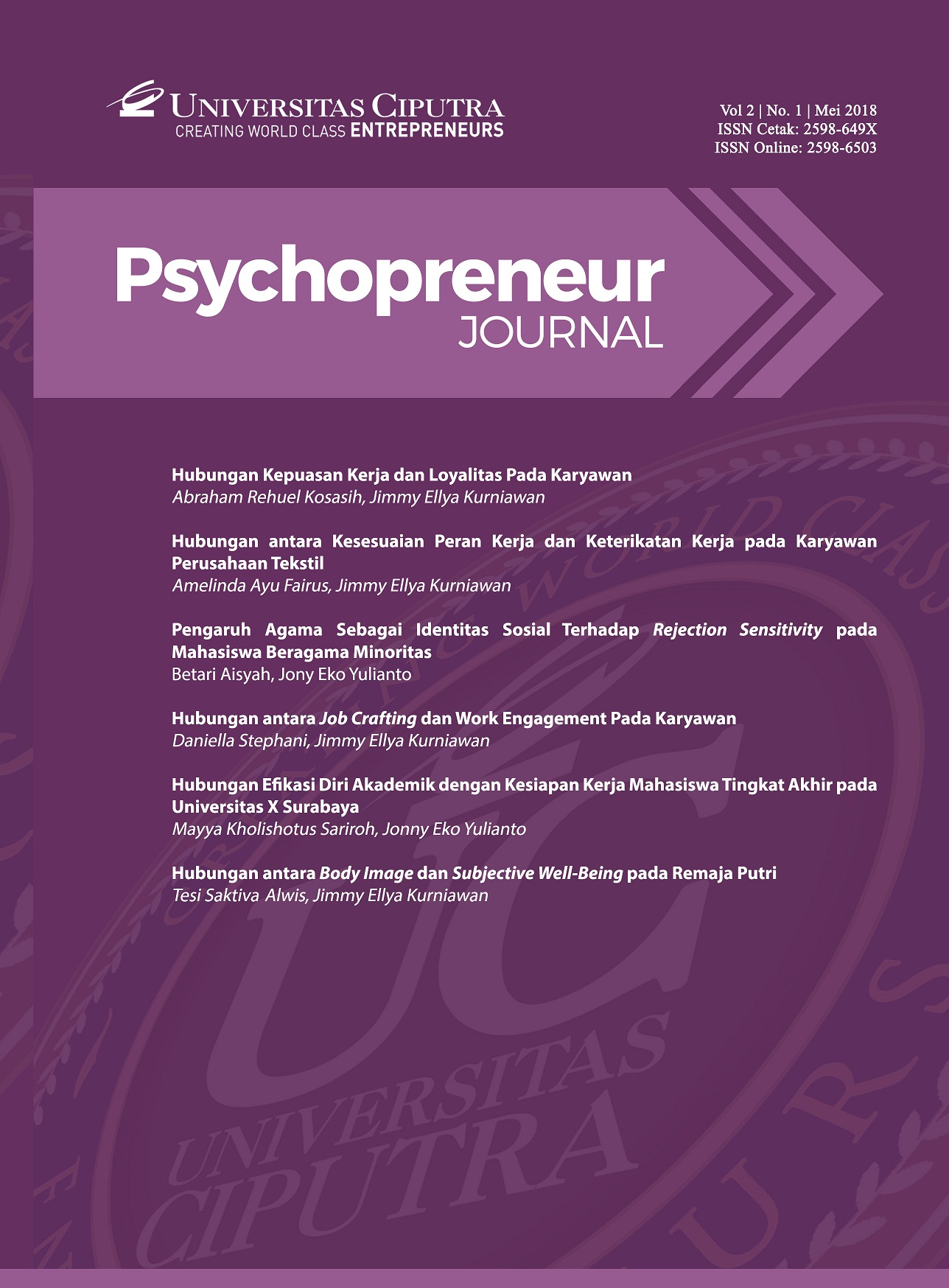
Hubungan antara Body Image dan Subjective Well-Being Pada Remaja Putri
Article Sidebar
Published:
Jul 15, 2019
Main Article Content
Abstract
The assessment of body shape or often called the body image is very common among female adolescents. Previous studies showed the body image greatly affected the psychological well-being of adolescents. Young women who considered themselves people with worse body tended to undergo depression. This perception is likely to inhibit their subjective well-beings. In reality, the body image did not affect subjective well-being of the individual. This research aims to investigate the relations between body image and subjective well-being in adolescent girls. This research is a correlational quantitative study. The subjects consisted of 175 Faculty of Fashion and Design Business of "X" University in Surabaya, aged 18-24 years. The data collection technique was Total Population Study. Having used SPSS, this study found the statistical calculation where ρ = 0.432 and p-value = 0.000 in the body image and subjective well-being satisfaction dimensions. Meanwhile, the body image and subjective well-being subjective dimensions were r = 0.474 and p-value = 0.000.
Article Details
How to Cite
Alwis, T. S., & Kurniawan, J. E. (2019). Hubungan antara Body Image dan Subjective Well-Being Pada Remaja Putri. Psychopreneur Journal, 2(1), 52–60. https://doi.org/10.37715/psy.v2i1.867
Issue
Section
Articles

This work is licensed under a Creative Commons Attribution-ShareAlike 4.0 International License.
References
Cash, T. F., Ancis, J. R., & Strachan, M. D. (1997). Gender attitudes, feminist identity, and body images among college women. Sex roles, 36(7/8), 433-477.
Cash T. F., & Pruzinsky T. (2002). Body image: A handbook of theory, research, and clinical practice. New York: Guilford.
Diener, E. (1984). Subjective well-being. Psychological Bulletin, 95(3), 542-575.
Diener, E. (2000). Subjective well-being: The science of happiness and a proposal for national index. American Psychology, 55(1), 34-43.
Diener, E., Emmons, R. A., Larsen R.J., & Griffin, S. (1985). The satisfaction with life scale. Journal of Personality Assessment, 49(1), 71-75.
Diener, E., Oishi,S., & Lucas, R.E. (2013). Personality, culture, and subjective well-being: emotional and cognitive evaluations of life. Annual Review of Psychology, 54, 403-425.
Cash T. F., & Pruzinsky T. (2002). Body image: A handbook of theory, research, and clinical practice. New York: Guilford.
Diener, E. (1984). Subjective well-being. Psychological Bulletin, 95(3), 542-575.
Diener, E. (2000). Subjective well-being: The science of happiness and a proposal for national index. American Psychology, 55(1), 34-43.
Diener, E., Emmons, R. A., Larsen R.J., & Griffin, S. (1985). The satisfaction with life scale. Journal of Personality Assessment, 49(1), 71-75.
Diener, E., Oishi,S., & Lucas, R.E. (2013). Personality, culture, and subjective well-being: emotional and cognitive evaluations of life. Annual Review of Psychology, 54, 403-425.