



The Effects of Work Autonomy towards Employees Loyalty in Millennial Generation with Work-Life Balance as Mediator
Article Sidebar
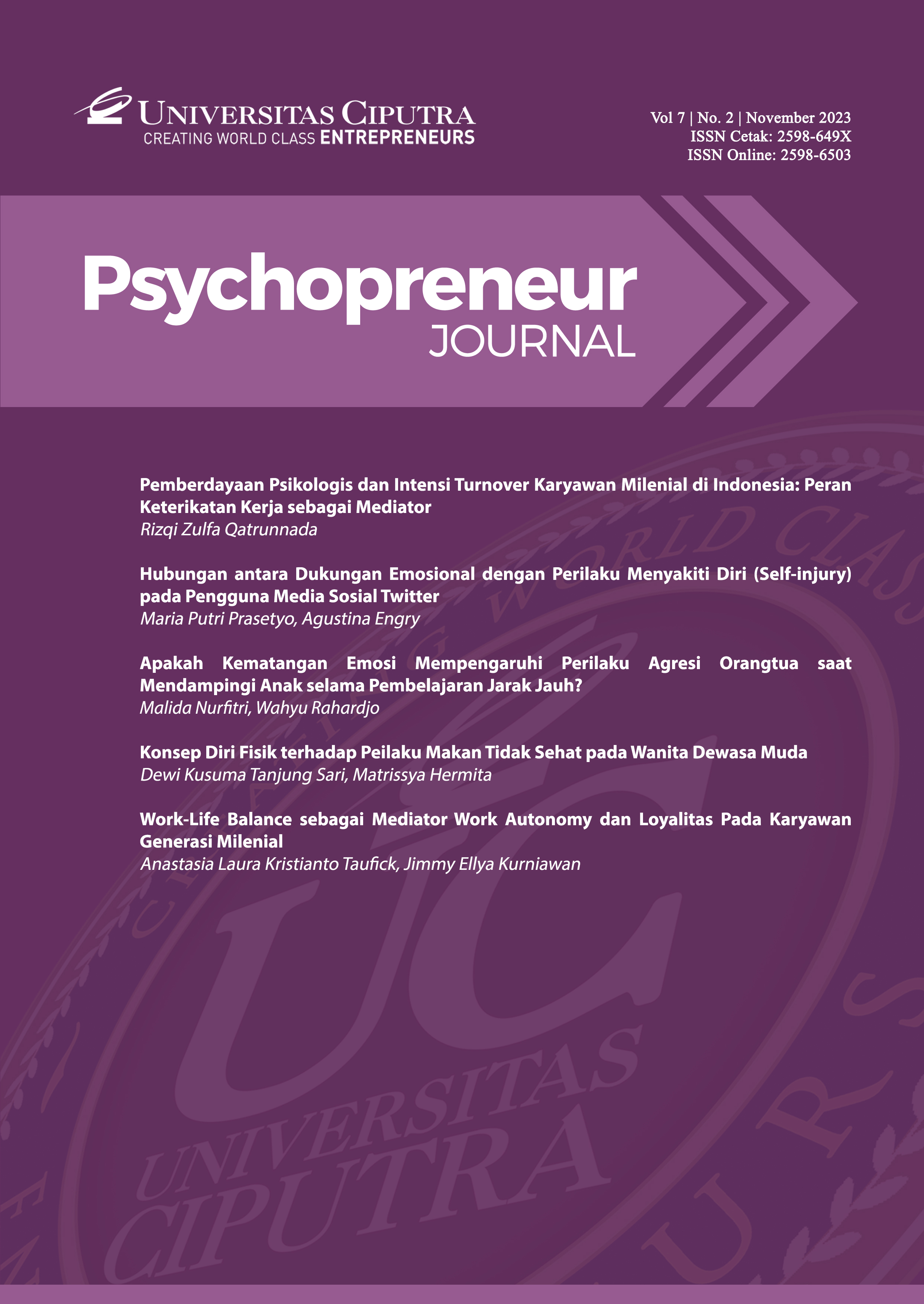
Main Article Content
Abstract
The active workforce in Indonesia is dominated by the millennial generation. However, millennial employees have a characteristic that tend to be disloyal when their needs are not facilitated. Past researches have shown work-life balance as one of their main needs. Hypothesis of this research is the effects of work autonomy towards employees loyalty in millennial generation with work-life balance as mediator. This is a quantitative research and datas were collected using the work autonomy scale developed by Breaugh (1999), the work-life balance scale developed by Fisher, et al (2009), and the employee loyalty scale developed by Dutta and Dhir (2021). This research is a total population study with 288 respondents from PT MF. The results showed that work-life balance couldn’t moderate the effect of work autonomy on millennial employee loyalty (p>.05), because the majority of respondents were male employees who view work autonomy as a way to develop loyalty and not work-life balance, considering their role as breadwinner for their family.
Article Details

This work is licensed under a Creative Commons Attribution-ShareAlike 4.0 International License.

This work is licensed under a Creative Commons Attribution-ShareAlike 4.0 International License.
References
Adawiyah, S., Karisga, C. D., Noveriza, R., Mosyani, R. F., & Riyanto, S. (2019). The effect of work-life balance and employee satisfaction on employee loyalty Ofgpret Studio. IOSR Journal Of Humanities And Social Science, 25(1), 59-63. DOI:10.9790/0837-2501015963
Badri, S. K. Z., & Panatik, S. A. (2020). The roles of job autonomy and self-efficacy to improve academics’ work-life balance. Asian Academy of Management Journal, 25(2), 85-108. DOI: 10.21315/aamj2020.25.2.4
Breaugh, J. A. (1999). Further investigation of the work autonomy scales: Two studies. Journal of Business and Psychology, 13(3), 357–373. DOI: 10.1023/A:1022926416628
Chandra, D. O., Hubeis, A., & Sukandar, D. (2017). Kepuasan kerja generasi X dan generasi Y terhadap komitmen kerja di Bank Mandiri Palembang. Jurnal Aplikasi Bisnis dan Manajemen, 3(1), 12-22. https://doi.org/10.17358/jabm.3.1.12
Cho, S., Johanson, M. M., & Guchait, P. (2009). Employees intent to leave: A comparison of determinants of intent to leave versus intent to stay. International Journal of Hospitality Management, 28(3), 374–381.
Clarke, M. C., Koch, L. C., & Hill, E. J. (2004). The work-family interface: Differentiating balance and fit. Family and Consumer Sciences Research Journal, 33(2), 121–140. DOI: 10.1177/1077727X04269610
Dutta, T., & Dhir, S. (2021). Employee loyalty: Measurement and validation. Global Business Review, 1-18. DOI: 10.1177/0972150921990809
Erickson, T. (2008). Plugged in: The generation Y guide to thriving at work. Boston: Harvard Business Press.
Fanani, I., Djati, S. P, & Silvanita, K. (2016). Pengaruh kepuasan kerja dan komitmen organisasi terhadap organizational citizenship behavior (OCB): Studi kasus RSU UKI. Fundamental Management Journal, 1(4), 40-53. DOI: 10.33541/fjm.v1i04.246
Fisher, G. G., Bulger, C. A., & Smith, C. S. (2009). Beyond work and family: A measure of work/nonwork interference and enhancement. Journal of Occupational Health Psychology, 14(4), 441–456. DOI: 10.1037/a0016737
Ganapathi, I. M. D., & Gilang, A. (2016). Pengaruh work-life balance terhadap kepuasan kerja karyawan (studi pada PT. Bio Farma Persero). e-Proceeding of Management, 3(1), 506-511.
Gunawan, T. M. E., & Franksiska, R. (2020). Pengaruh pengaturan kerja yang fleksibel terhadap kinerja karyawan dengan work life balance sebagai variabel mediasi. Procuratio: Jurnal Ilmiah Manajemen, 8(3), 308-321. DOI: 10.35145/procuratio.v8i3.698
Hasibuan, M. (2019). Manajemen sumber daya manusia. Bandung: PT. Bumi Aksa.
Hawa, M. A., & Nurtjahjanti, H. (2018). Hubungan antara work-life balance dengan loyalitas karyawan pada PT Hanil Indonesia di Boyolali. Empati, 7(1), 424–429.
Hofäcker, D., & König, S. (2013). Flexibility and work‐life conflict in times of crisis: A gender perspective. International Journal of Sociology and Social Policy, 33(9/10), 613–635. DOI: 10.1108/IJSSP-04-2013-0042
Kabir, M. A., & Rahman, M. (2019). Effects of work life balance on employee loyalty in private commercial banks of Bangladesh. Journal of Economics and Sustainable Development, 10(14), 178-191.
Khateeb, F. R. (2021). Work life balance: A review of theories, definitions and policies. Cross-Cultural Management Journal, 23(1), 27-55.
Kominfo. (2021, Januari). Angkatan Kerja Produktif Melimpah. Diunduh dari https://www.kominfo.go.id/content/detail/33004/angkatan-kerja-produktif-melimpah/0/artikel
Kultalahti, S., & Viitala, R. (2015). Generation Y - Challenging clients for HRM?. Journal of Managerial Psychology, 30(1), 1–27. DOI: 10.1108/JMP-08-2014-0230
Lestary, L., & Harmon. (2017). Pengaruh lingkungan kerja terhadap kinerja karyawan. Jurnal Riset Bisnis dan Investigasi, 3(2), 94-103.
Lewis, S., & Humbert, A. L. (2010). Discourse or reality? “Work-life balance’’, flexible working policies and the gendered organization. Equality, Diversity and Inclusion: An International Journal, 29(3), 239–254. DOI: 10.1108/02610151011028840
Luntungan, I., Hubeis, A. V. S., Sunarti, E., & Maulana, A. (2014). Strategi pengelolaan generasi Y di industri perbankan. Jurnal Managemen Teknologi, 13(2), 219-240. DOI: 10.12695/jmt.2014.13.2.7
Luscombe, J., Lewis, I., & Biggs, H. C. (2013). Essential elements for recruitment and retention: Generation Y. Education and Training, 55(3), 272–290. DOI: 10.1108/00400911311309323
Ma’ruf, R. (2021). Pengaruh kompensasi dan work life balance terhadap loyalitas karyawan. Psikoborneo: Jurnal Ilmiah Psikologi, 9(1), 110-120. DOI: 10.30872/psikoborneo.v9i1.5671
Nindyati, A. D. (2017). Pemaknaan loyalitas karyawan pada generasi X dan generasi Y (studi pada karyawan di Indonesia). Journal of Psychological Science and Profession, 1(1), 59-66. DOI: 10.24198/jpsp.v1i3.15230
Nirmala, R., Mariskha, S. E., & Sari, M. T. (2019). pengaruh work life balance terhadap loyalitas karyawan di CV Banjar Sari Catering Samarinda. Motivasi, 7(1).
Nurhasan, R. (2017). Kepuasan kerja dan loyalitas generasi Y. Jurnal Wacana Ekonomi, 17(1), 13-23. DOI: 10.52434/jwe.v17i1.221
Pallant, J. (2020). SPSS Survival Manual: A Step by Step Guide to Data Analysis Using IBM SPSS (7th ed.). Routledge. DOI: 10.4324/9781003117452
Puteh, F., Kaliannan, M., & Alam, N. (2015). Assessing gen Y impact on organizational performance: An analysis from top management perspective. Journal of Administrative Science, 12(1), 47-59.
Putro, T. A. D., Prameswari, N. A., & Qomariyah, O. (2020). Stres kerja, keterlibatan kerja, dan intensi turnover pada generasi milenial. Psikostudia: Jurnal Psikologi, 9(2), 154-163. DOI: 10.30872/psikostudia.v9i2.3837
Rahmawati, A. (2016). Pengaruh keseimbangan kehidupan kerja (work life balance) dan kepuasan kerja terhadap loyalitas guru SMK swasta di Kecamatan Cakung Jakarta Timur. JOM FISIP, 7(1), 1215-1224. DOI: 10.21009/jmp.07103.
Rokhmah, B. E., Riani, A. L. (2005). Keterkaitan antara komitmen afektif dengan intensi turnover pada karyawan bagian produksi di PT Usman Jaya Mekar Magelang. Jurnal Ilmiah Teknik Industri, 4(2), 78-85. DOI: 10.23917/jiti.v4i2.1366
Rusbult, C. E., Farrel, D., Rogers, G., & Mainous, A. G. (2017). Impact of exchange variables on exit, voice, loyalty, and neglect: An integrative model of responses to declining job satisfaction. Academy of Management Journal, 31(3), 599–627. DOI: 10.5465/256461
Saragih, S. (2011). The effects of job autonomy on work outcomes: Self efficacy as an intervening variable. International Research Journal of Business Studies, 4(3), 203-215.
Shahzad , M. B. (2016). Impact of perceived job autonomy on turnover intention in sales & marketing managers of services industry: Moderating role of procedural and distributive justice. Science International: Lahore, 28(3), 2881-2896.
Sisodia, S., & Das, I. (2013). Effect of job autonomy upon organizational commitment of employees at different hierarchical level. Psychological Thought, 6(2), 241-251. DOI: 10.5964/psyct.v6i2.65
Skinner, N., & Pocock, B. (2011). Flexibility and Work-Life Interference in Australia. Journal of Industrial Relations, 53(1), 65–82. DOI: 10.1177/0022185610390297
Solnet, D., & Hood, A. (2008). Generation Y as hospitality employees: Framing a research agenda. Journal of Hospitality and Tourism Management, 15(1), 59–68. DOI:10.1375/jhtm.15.1.59
Stafford, D. E., & Griffis, H. S. (2008). A review of millennial generation characteristics and military workforce implications. Virginia: CAN.
Subramaniam, A. G., Overton, B. J., & Maniam, C. B. (2015). Flexible working arrangements, work-life balance and women in Malaysia. International Journal of Social Science and Humanity, 5(1), 34–38. DOI: 10.7763/ijssh.2015.v5.417
Suharnomo, D. A. S. (2022). Analisis pengaruh otonomi kerja (job autonomy), keterlibatan kerja (work engagement), dan kepuasan kerja (job satisfaction) terhadap keinginan untuk keluar (turnover intention). Diponegoro Journal of Management, 11(1), 1-14.
Utomo, W. P. (2019). Indonesia Millennial Report 2019: Memahami Perilaku Milenial Indonesia. IDN Research Institute. Diunduh dari: https://cdn.idntimes.com/content-documents/indonesia-millennial-report-2019-by-idn-times.pdf
Vuong, B., Tung, D., Tushar, H., Quan, T., & Giao, H. (2021). Determinates of factors influencing job satisfaction and organizational loyalty. Management Science Letters, 11(1), 203-212.
Westman, M., Brough, P., Kalliath, T. (2009). Expert commentary on work–life balance and crossover of emotions and experiences: Theoretical and practice advancements. Journal of Organizational Behavior, 30(5), 587-595. DOI: 10.1002/job.616
Weyland, A. (2011). Engagement and talent management of generation Y. Industrial and Commercial Training, 43(7), 439-445. DOI: 10.1108/00197851111171863