



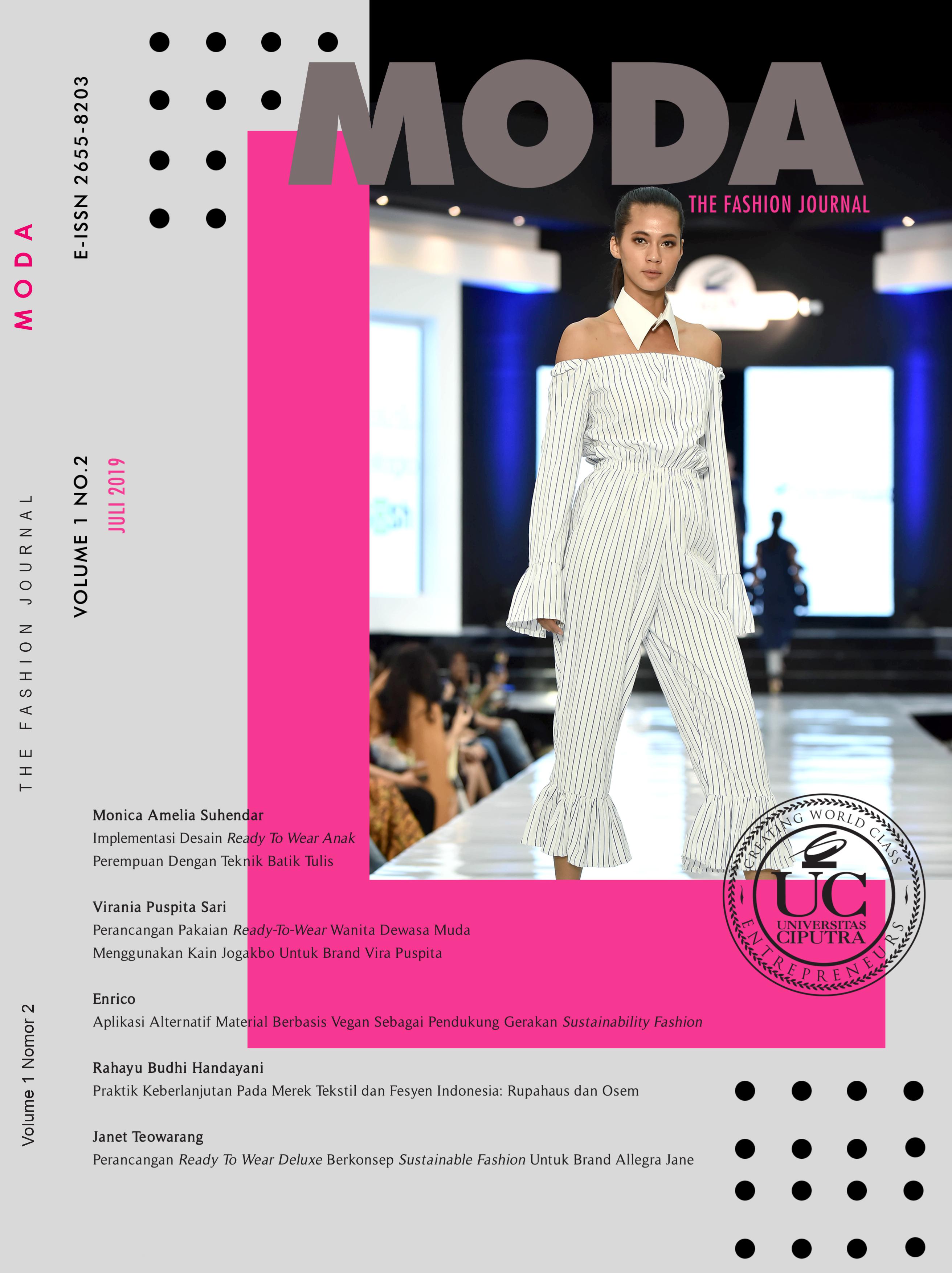
PRAKTIK KEBERLANJUTAN PADA MEREK TEKSTIL DAN FESYEN INDONESIA: RUPAHAUS DAN OSEM
Article Sidebar
Published:
Jul 22, 2019
Keywords:
Indonesian Brand, Fashion, Sustainability, Textile
Main Article Content
Abstract
The Study of Sustainability Practices in Indonesian Textile and Fashion Brands: Rupahaus and Osem describe how the principles of sustainability in fashion and textiles are practiced. Generally, environmentally friendly brands are often associated with the use of natural materials. Whereas in the production process of natural materials such as cotton also have a negative impact on the environment because of the need for the use of a lot of pesticides and fertilizers. Thus, the practice of sustainability in fashion and textiles needs to be seen from the production process, distribution process, consumption process, to final disposal. Using a qualitative descriptive approach, this paper further examines the existing sustainability practices of Indonesian fashion brands with purposive sampling on the Rupahaus and Osem
Article Details
How to Cite
Handayani, R. B. (2019). PRAKTIK KEBERLANJUTAN PADA MEREK TEKSTIL DAN FESYEN INDONESIA: RUPAHAUS DAN OSEM. MODA, 1(2), 133–142. https://doi.org/10.37715/moda.v1i2.882
Issue
Section
Articles

This work is licensed under a Creative Commons Attribution-ShareAlike 4.0 International License.
References
MacKenzie, D. 1997.Green Design: Design for the Environment. Books Nippan.
Fletcher, K. 2008. Sustainable Fashion and Textiles. UK: Earthscan Publication.
Henninger CE, Alevizou PJ, Oates CJ. What is sustainable fashion?, Journal of Fashion Marketing and Management: An International Journal. 2016; Vol. 20 Issue: 4, pp.400-416. Available from: https://dx.doi. org/10.1108/JFMM-07-2015-0052
Jung, S. Slow Fashion: Understanding Potential Consumers and Creating Customer Value For Increasing Purchase Intetntion and Willingness To Pay a Price Premium. Dissertation Doctoral of Pholosophy.The University of North Carolina. Available from: https://libres.uncg.edu/ir/uncg/f/Jung_ uncg_0154D_11493.pdf
Mukherjee, S. Environmental and Social Impact of Fashion: Towards an Eco-friendly, Ethical Fashion. International Journal of Interdisciplinary and Multidisciplinary Studies, 2015. Vol.2. No 3, p: 22-35. Available from: www.ijims.com
Fletcher, K. 2008. Sustainable Fashion and Textiles. UK: Earthscan Publication.
Henninger CE, Alevizou PJ, Oates CJ. What is sustainable fashion?, Journal of Fashion Marketing and Management: An International Journal. 2016; Vol. 20 Issue: 4, pp.400-416. Available from: https://dx.doi. org/10.1108/JFMM-07-2015-0052
Jung, S. Slow Fashion: Understanding Potential Consumers and Creating Customer Value For Increasing Purchase Intetntion and Willingness To Pay a Price Premium. Dissertation Doctoral of Pholosophy.The University of North Carolina. Available from: https://libres.uncg.edu/ir/uncg/f/Jung_ uncg_0154D_11493.pdf
Mukherjee, S. Environmental and Social Impact of Fashion: Towards an Eco-friendly, Ethical Fashion. International Journal of Interdisciplinary and Multidisciplinary Studies, 2015. Vol.2. No 3, p: 22-35. Available from: www.ijims.com