



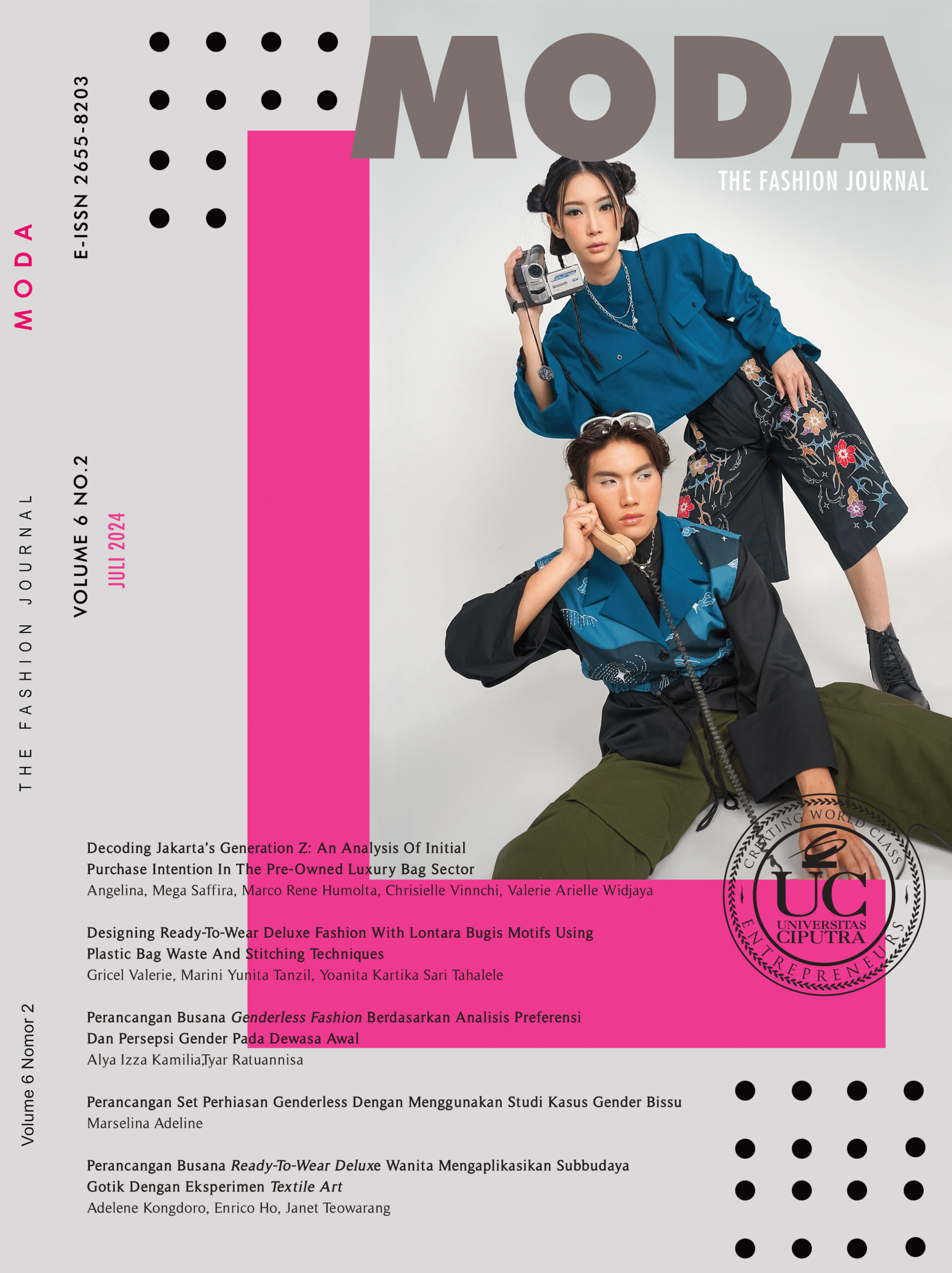
Decoding Jakarta's Generation Z: An Analysis of Initial Purchase Intention in the Pre-Owned Luxury Bag Sector
Article Sidebar
Main Article Content
Abstract
In today's consumer landscape, there is a noticeable trend towards exploring different ways of obtaining luxury goods, especially seen in the increasing interest in the pre-owned luxury bags market among Generation Z consumers in Jakarta. This study aims to explore the perceptions of value and risk, product attitudes, and the credibility of authenticity claims regarding the initial purchase intention of pre-owned luxury bags among this demographic. Built upon a thorough examination of current literature and initial exploratory research, an online survey was designed to illustrate the connections among the variables proposed in the conceptual framework.
Article Details

This work is licensed under a Creative Commons Attribution-ShareAlike 4.0 International License.

This work is licensed under a Creative Commons Attribution-ShareAlike 4.0 International License.
References
Ajzen, I., & Fishbein, M. (2000). Attitudes and the Attitude-Behavior Relation: Reasoned and Automatic Processes. European Review of Social Psychology, 11(1), 1–33. https://doi.org/10.1080/14792779943000116
Amatulli, C., de Angelis, M., & Donato, C. (2020). An investigation on the effectiveness of hedonic versus utilitarian message appeals in luxury product communication. Psychology & Marketing, 37(4), 523–534. https://doi.org/10.1002/mar.21320
Amatulli, C., De Angelis, M., Korschun, D., & Romani, S. (2018). Consumers’ perceptions of luxury brands’ CSR initiatives: An investigation of the role of status and conspicuous consumption. Journal of Cleaner Production, 194, 277–287. https://doi.org/10.1016/J.JCLEPRO.2018.05.111
Athwal, N., Wells, V. K., Carrigan, M., & Henninger, C. E. (2019). Sustainable Luxury Marketing: A Synthesis and Research Agenda. International Journal of Management Reviews, 21(4), 405–426. https://doi.org/10.1111/IJMR.12195
Banananina. (n.d.). 2023. Retrieved February 11, 2023, from https://www.banananina.co.id/
Bauer, R. A. (1960). Consumer behavior as risk-taking. In R. S. Hancock (Ed.), Dynamic marketing for a changing world (pp. 389–398). American Marketing Association.
BCG. (2019). 2019 True-Luxury Global Consumer Insight.
BCG Powered by Vestiaire Collective. (2022). What an Accelerating Secondhand Market Means for Fashion Brands and Retailers.
Beauloye, F. E. (2022, November 17). Luxury Resale: A Secondhand Strategy for Brands. https://luxe.digital/business/digital-luxury-reports/luxury-resale-transformation/
Belk, R. W. (1988). Possessions and the Extended Self. Journal of Consumer Research, 15(2), 139. https://doi.org/10.1086/209154
Belk, R. W. (1995). Collecting as luxury consumption: Effects on individuals and households. Journal of Economic Psychology, 16(3), 477–490. https://doi.org/10.1016/0167-4870(95)98956-X
Bertrandias, L., & Goldsmith, R. E. (2006). Some psychological motivations for fashion opinion leadership and fashion opinion seeking. Journal of Fashion Marketing and Management: An International Journal, 10(1), 25–40. https://doi.org/10.1108/13612020610651105
Budianto, Y. (2023, August 25). The Inevitability of Jakarta Transforming into a World Standard City - Kompas.id. https://www.kompas.id/baca/english/2023/08/25/en-keniscayaan-jakarta-bertransformasi-menjadi-kota-berstandar-dunia
Cervellon, M. C., Carey, L., & Harms, T. (2012). Something old, something used: Determinants of women’s purchase of vintage fashion vs second-hand fashion. International Journal of Retail and Distribution Management, 40(12), 956–974. https://doi.org/10.1108/09590551211274946/FULL/XML
Chi, T., & Kilduff, P. P. D. (2011). Understanding consumer perceived value of casual sportswear: An empirical study. Journal of Retailing and Consumer Services, 18(5), 422–429. https://doi.org/10.1016/J.JRETCONSER.2011.06.004
Danziger, P. N. (2019, May 29). 3 Ways Millennials And Gen-Z Consumers Are Radically Transforming The Luxury Market. https://www.forbes.com/sites/pamdanziger/2019/05/29/3-ways-millennials-and-gen-z-consumers-are-radically-transforming-the-luxury-market/?sh=7afd9c99479f
Deloitte. (2020). Global Powers of Luxury Goods 2020 .
Dowling, G. R., & Staelin, R. (1994). A Model of Perceived Risk and Intended Risk-Handling Activity. Journal of Consumer Research, 21(1), 119. https://doi.org/10.1086/209386
Eastman, J. K., Goldsmith, R. E., & Flynn, L. R. (1999). Status Consumption in Consumer Behavior: Scale Development and Validation. Journal of Marketing Theory and Practice, 7(3), 41–52. https://doi.org/10.1080/10696679.1999.11501839
Engel, J. F., & Blackwell, R. D. (1982). Consumer behavior. 690. https://books.google.com/books/about/Consumer_Behavior.html?id=BgaJuAAACAAJ
Etikan, I., & Bala, K. (2017). Sampling and Sampling Methods. Biometrics & Biostatistics International Journal, 5(6). https://doi.org/10.15406/bbij.2017.05.00149
Fornell, C., & Larcker, D. F. (1981). Evaluating Structural Equation Models with Unobservable Variables and Measurement Error. Journal of Marketing Research, 18(1), 39. https://doi.org/10.2307/3151312
Guiot, D., & Roux, D. (2010). A second-hand shoppers’ motivation scale: Antecedents, consequences, and implications for retailers. Journal of Retailing, 86(4), 355–371. https://doi.org/10.1016/J.JRETAI.2010.08.002
Hair, J. F., Black, W. C., Babin, B. J., & Anderson, R. E. (2010). Multivariate Data Analysis. 785. https://books.google.com.my/books/about/Multivariate_Data_Analysis.html?id=JlRaAAAAYAAJ&pgis=1
Hair, J. F. Jr., Hult, G. T. M., Ringle, C. M., & Sarstedt, M. (2017). A Primer on Partial Least Squares Structural Equation Modeling (PLS-SEM). Thousand Oaks. Sage, 165.
Hair, J. F., Ringle, C. M., & Sarstedt, M. (2011). PLS-SEM: Indeed a Silver Bullet. Journal of Marketing Theory and Practice, 19(2), 139–152. https://doi.org/10.2753/MTP1069-6679190202
Hair, J. F., Sarstedt, M., Hopkins, L., & Kuppelwieser, V. G. (2014). Partial least squares structural equation modeling (PLS-SEM): An emerging tool in business research. European Business Review, 26(2), 106–121. https://doi.org/10.1108/EBR-10-2013-0128/FULL/XML
Hartono, H. B. (2023, October 21). Imagining Jakarta as an Intercultural City - Kompas.id. https://www.kompas.id/baca/english/2023/10/20/en-membayangkan-jakarta-sebagai-kota-interkultural
Hellier, P. K., Geursen, G. M., Carr, R. A., & Rickard, J. A. (2003). Customer repurchase intention. European Journal of Marketing, 37(11/12), 1762–1800. https://doi.org/10.1108/03090560310495456
Henseler, J., Ringle, C. M., & Sinkovics, R. R. (2009). The use of partial least squares path modeling in international marketing (pp. 277–319). https://doi.org/10.1108/S1474-7979(2009)0000020014
Horton, R. L. (1976). The structure of perceived risk: Some further progress. Journal of the Academy of Marketing Science, 4(4), 694–706. https://doi.org/10.1007/BF02729830
HuntStreet. (2023). https://www.huntstreet.com/designer
Hur, E. (2020). Rebirth fashion: Secondhand clothing consumption values and perceived risks. Journal of Cleaner Production, 273, 122951. https://doi.org/10.1016/j.jclepro.2020.122951
Johnson, M. D., Herrmann, A., & Huber, F. (2006). The Evolution of Loyalty Intentions. Journal of Marketing, 70(2), 122–132. http://scholarship.sha.cornell.edu/articleshttp://scholarship.sha.cornell.edu/articles/435/
Kang, J., & Kim, S.-H. (2013). What Are Consumers Afraid of? Understanding Perceived Risk toward the Consumption of Environmentally Sustainable Apparel. Family and Consumer Sciences Research Journal, 41(3), 267–283. https://doi.org/10.1111/fcsr.12013
Kessous, A., & Valette-Florence, P. (2019). “From Prada to Nada”: Consumers and their luxury products: A contrast between second-hand and first-hand luxury products. Journal of Business Research, 102, 313–327. https://doi.org/10.1016/J.JBUSRES.2019.02.033
Kim, C. J. (1992). Risk Perceived by Consumers in Apparel Buying Situation ( II ) Types of Risk Reduction Methods and Their Relationships with Risk Types and Consumers’ Demographic Variables. Journal of the Korean Society of Clothing and Textiles, 16(1), 73–83.
Kim, I. H., Jung, H. J., & Lee, Y. (2021). Consumers’ Value and Risk Perceptions of Circular Fashion: Comparison between Secondhand, Upcycled, and Recycled Clothing. Sustainability, 13(3), 1208. https://doi.org/10.3390/su13031208
Kim, J.-H., & Song, H. (2020). The influence of perceived credibility on purchase intention via competence and authenticity. International Journal of Hospitality Management, 90, 102617. https://doi.org/10.1016/j.ijhm.2020.102617
Kline, R. B. (2010). Principles and practice of structural equation modeling, 3rd ed. (3rd ed.). Guilford Press. https://psycnet.apa.org/record/2010-18801-000
Koay, K. Y., Cheah, C. W., & Lom, H. S. (2022). Does perceived risk influence the intention to purchase second-hand clothing? A multigroup analysis of SHC consumers versus non-SHC consumers. Journal of Product & Brand Management. https://doi.org/10.1108/JPBM-11-2021-3721
Lang, C. (2018). Perceived risks and enjoyment of access-based consumption: identifying barriers and motivations to fashion renting. Fashion and Textiles, 5(1), 1–18. https://doi.org/10.1186/S40691-018-0139-Z/FIGURES/1
Lang, C., & Zhang, R. (2019). Second-hand clothing acquisition: The motivations and barriers to clothing swaps for Chinese consumers. Sustainable Production and Consumption, 18, 156–164. https://doi.org/10.1016/j.spc.2019.02.002
Leibenstein, H. (1950). Bandwagon, snob, and veblen effects in the theory of consumers’ demand. Quarterly Journal of Economics, 64(2), 183–207. https://doi.org/10.2307/1882692
Liang, Y., Lee, S. H., & Workman, J. E. (2020). Implementation of Artificial Intelligence in Fashion: Are Consumers Ready? Clothing and Textiles Research Journal, 38(1), 3–18. https://doi.org/10.1177/0887302X19873437/ASSET/IMAGES/LARGE/10.1177_0887302X19873437-FIG1.JPEG

Loria, K., Lee, S., & York, A. (2023, May 30). Which Generation Am I? Boomers, Millennials, Gen X, Generation Z Birth Years. https://www.businessinsider.com/generation-you-are-in-by-birth-year-millennial-gen-x-baby-boomer-2018-3
Lou, X., Chi, T., Janke, J., & Desch, G. (2022). How Do Perceived Value and Risk Affect Purchase Intention toward Second-Hand Luxury Goods? An Empirical Study of U.S. Consumers. Sustainability 2022, Vol. 14, Page 11730, 14(18), 11730. https://doi.org/10.3390/SU141811730
Martinez, R., & Masron, I. N. (2020). Jakarta: A city of cities. Cities (London, England), 106, 102868. https://doi.org/10.1016/J.CITIES.2020.102868
Minshall, B., Winakor, G., & Swinney, J. L. (1982). Fashion Preferences of Males and Females, Risks Perceived, and Temporal Quality of Styles. Home Economics Research Journal, 10(4), 369–379. https://doi.org/10.1177/1077727X8201000408
Oh, H., Prado, P. H. M., Korelo, J. C., & Frizzo, F. (2019). The effect of brand authenticity on consumer–brand relationships. Journal of Product & Brand Management, 28(2), 231–241. https://doi.org/10.1108/JPBM-09-2017-1567
Okonkwo, U. (2016). Luxury fashion branding: Trends, tactics, techniques. Luxury Fashion Branding: Trends, Tactics, Techniques, 1–332. https://doi.org/10.1007/978-0-230-59088-5/COVER
Park, H. S., & Kim, H. S. (1998). A Study on the Dimensions of Clothing Attitudes. Journal of the Korean Society of Clothing and Textiles, 22(2), 279–289.
Persson, O., & Hinton, J. B. (2023). Second-hand clothing markets and a just circular economy? Exploring the role of business forms and profit. Journal of Cleaner Production, 390, 136139. https://doi.org/10.1016/j.jclepro.2023.136139
Phau, I., & Prendergast, G. (2000). Consuming luxury brands: The relevance of the ‘Rarity Principle.’ Journal of Brand Management 2000 8:2, 8(2), 122–138. https://doi.org/10.1057/PALGRAVE.BM.2540013
Price, L. L., Arnould, E. J., & Folkman Curasi, C. (2000). Older Consumers’ Disposition of Special Possessions. Journal of Consumer Research, 27(2), 179–201. https://doi.org/10.1086/314319
Rambourg, E. (2014). The Bling Dynasty : Why the Reign of Chinese Luxury Shoppers Has Only Just Begun. 280.
Rausch, T. M., & Kopplin, C. S. (2021). Bridge the gap: Consumers’ purchase intention and behavior regarding sustainable clothing. Journal of Cleaner Production, 278, 123882. https://doi.org/10.1016/j.jclepro.2020.123882
Roselius, T. (1971). Consumer Rankings of Risk Reduction Methods. Journal of Marketing, 35(1), 56–61. https://doi.org/10.1177/002224297103500110
Ryding, D., Henninger, C. E., & Cano, M. B. (2018). Introduction to vintage luxury fashion—exploring the rise of the secondhand clothing trade. Vintage Luxury Fashion, 1–10. https://doi.org/10.1007/978-3-319-71985-6
Second Chance. (2023). https://secondchancebag.com/
Sekaran, U., & Bougie, R. (2016). Research Methods For Business: A Skill Building Approach (7th ed.). Wiley. https://openlibrary.telkomuniversity.ac.id/home/catalog/id/155793/slug/research-methods-for-business-a-skill-building-approach.html
Shaizatulaqma, K. A., Mohan, T., & Goh, Y.-N. (2018). Influence of consumers’ perceived risk on consumers’ online purchase intention. Journal of Research in Interactive Marketing, 12(3), 309–327. https://doi.org/10.1108/JRIM-11-2017-0100
Sheth, J. N., Newman, B. I., & Gross, B. L. (1991). Why we buy what we buy: A theory of consumption values. Journal of Business Research, 22(2), 159–170. https://doi.org/10.1016/0148-2963(91)90050-8
Shimp, T. A., & Bearden, W. O. (1982). Warranty and Other Extrinsic Cue Effects on Consumers’ Risk Perceptions. Journal of Consumer Research, 9(1), 38. https://doi.org/10.1086/208894
Shukla, P., Banerjee, M., & Singh, J. (2016). Customer commitment to luxury brands: Antecedents and consequences. Journal of Business Research, 69(1), 323–331. https://doi.org/10.1016/j.jbusres.2015.08.004
Statista. (2021). Consumer willingness to buy secondhand apparel by age worldwide 2021 | Statista. https://www.statista.com/statistics/828034/willingness-to-buy-secondhand-items-by-age-worldwide/
Stolz, K. (2022). Why Do(n’t) We Buy Second-Hand Luxury Products? Sustainability (Switzerland), 14(14). https://doi.org/10.3390/SU14148656
Stone, R. N., & Grønhaug, K. (1993). Perceived Risk: Further Considerations for the Marketing Discipline. European Journal of Marketing, 27(3), 39–50. https://doi.org/10.1108/03090569310026637/FULL/XML
Sweeney, J. C., & Soutar, G. N. (2001). Consumer perceived value: The development of a multiple item scale. Journal of Retailing, 77(2), 203–220. https://doi.org/10.1016/S0022-4359(01)00041-0
Tinkerlust. (2023). https://www.tinkerlust.com/luxury?page=3&per_page=24&sort_by=live_date&sort_dir=desc
Trizano-Hermosilla, I., & Alvarado, J. M. (2016). Best Alternatives to Cronbach’s Alpha Reliability in Realistic Conditions: Congeneric and Asymmetrical Measurements. Frontiers in Psychology, 7. https://doi.org/10.3389/fpsyg.2016.00769
Turunen, L. L. M., & Leipämaa-Leskinen, H. (2015). Pre-loved luxury: Identifying the meaning of second hand luxury possessions. Journal of Product and Brand Management, 24(1), 57–64. https://doi.org/10.1108/JPBM-05-2014-0603
Veblen, T. (1899). Theory of the Leisure Class. The Macmillan Company.
Vigneron, F., & Johnson, L. W. (2004). Measuring perceptions of brand luxury. Journal of Brand Management, 11(6), 484–506. https://doi.org/10.1057/palgrave.bm.2540194
Westbrook, R. A., & Oliver, R. L. (1991). The Dimensionality of Consumption Emotion Patterns and Consumer Satisfaction. Journal of Consumer Research, 18(1), 84. https://doi.org/10.1086/209243
Widiati, S. (2023, January 13). A Preloved Treasure Trove in Senayan . NOW! Jakarta. https://www.nowjakarta.co.id/a-preloved-treasure-trove-in-senayan/
Wiedmann, K.-P., Hennigs, N., & Siebels, A. (2009). Value-based segmentation of luxury consumption behavior. Psychology and Marketing, 26(7), 625–651. https://doi.org/10.1002/mar.20292
Willersdorf, S., Krueger, F., Estripeau, R., Gasc, M., & Mardon, C. (2020, October 20). The Fashion Industry’s Growing Secondhand Market | BCG. BCG. https://www.bcg.com/publications/2020/consumer-segments-behind-growing-secondhand-fashion-market%20
Yoo, F., Jung, H. J., & Oh, K. W. (2021). Motivators and Barriers for Buying Intention of Upcycled Fashion Products in China. Sustainability, 13(5), 2584. https://doi.org/10.3390/su13052584
Yu, S., & Lee, J. (2019). The Effects of Consumers’ Perceived Values on Intention to Purchase Upcycled Products. Sustainability, 11(4), 1034. https://doi.org/10.3390/su11041034
Zeithaml, V. A. (1988). Consumer Perceptions of Price, Quality, and Value: A Means-End Model and Synthesis of Evidence. Journal of Marketing, 52(3), 2–22. https://doi.org/10.1177/002224298805200302