



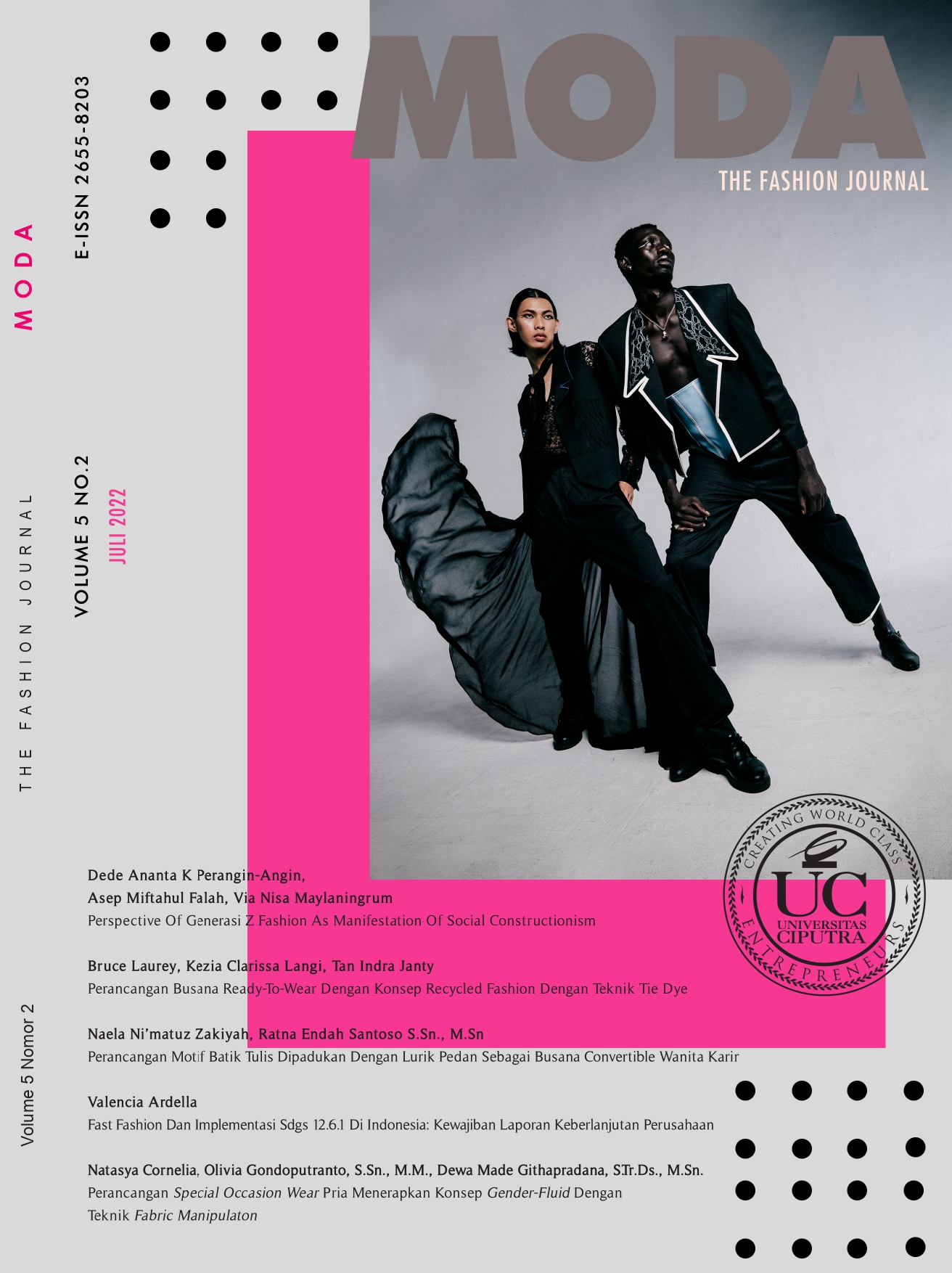
PERANCANGAN SPECIAL OCCASION WEAR PRIA MENERAPKAN KONSEP GENDER-FLUID DENGAN TEKNIK FABRIC MANIPULATON
Article Sidebar
Main Article Content
Abstract
Stereotip gender menjadi bagian utama masyarakat dan budaya yang berkaitan dengan seksualitas, dengan stigma terhadap pria berbusana feminin yang masih kuat. Namun, semakin luasnya pergeseran budaya memberi lebih banyak kebebasan dalam hidup, salah satunya fashion kontemporer sebagai bentuk ekspresi diri yang tidak terikat dengan identitas gender. Menswear kontemporer telah mengalami perubahan signifikan dalam beberapa tahun terakhir, menggabungkan elemen desain feminin tradisional sebagai bentuk ekspresi gaya. Fenomena ini dimaknai sebagai “gender-fluid” fashion yang menggunakan metode kualitatif mengambil model Design Thinking dengan memperoleh data melalui observasi dan wawancara mendalam terhadap kelompok narasumber ahli dan konsumen. Hasil implementasi pada perancangan menghasilkan koleksi gender-fluid special occasion menswear bergaya avant-garde untuk menentang stereotip menswear dan maskulinitas tradisional dengan siluet inovatif mulai dari detail struktural atau dekoratif hingga warna, kain, dan fabric manipulation. Perancangan koleksi menerapkan konsep tren gender-fluid mampu menjawab permasalahan sosial, seperti kebebasan berekspresi, kepercayaan diri, kreativitas dalam berbusana, serta menentang gagasan tradisional gender dan fashion tanpa menghilangkan hubungan di antara keduanya, tetapi dengan menciptakan persepsi yang lebih multidimensi. Gen Z dan Millennials sebagai generasi terbuka dan perilaku membeli yang materialistis dan instan sesuai dengan target bisnis rental and sales yang sustainable secara ekonomi. Perancangan diungkapkan melalui estetika high fashion yang fluid dan ekspresif.
Article Details

This work is licensed under a Creative Commons Attribution-ShareAlike 4.0 International License.

This work is licensed under a Creative Commons Attribution-ShareAlike 4.0 International License.
References
A. Muri Yusuf. (2017). Metode Penelitian Kuantitatif, Kualitatif & Penelitian Gabungan (1st ed.).
Bennett, P. (2019). Menswear in the Millennium: Bending the Gender Binary. In Fashion, Agency, and Empowerment (pp. 63–80). Bloomsbury Publishing Plc. https://doi.org/10.5040/9781350058293.ch-004
Bowstead, J. M. (2018). Menswear Revolution. Bloomsbury Publishing Plc. https://doi.org/10.5040/9781474289030
Fullmer, D. (2020). Elements and Principles of Design. In Studio Companion Series Design Basics (pp. 13–61). Bloomsbury Publishing Inc. https://doi. org/10.5040/9781501371707.ch-001
Rubinstein, R. P. (2019). Dress Codes. Routledge. https://doi.org/10.4324/9780429495281
Vänskä, A. (2017). Gender and Sexuality. In A Cultural History of Dress and Fashion in the Modern Age (pp. 107–130). Bloomsbury Publishing Plc. https://doi.org/10.5040/9781474206402.ch-005
Akdemir, N. (2018). Deconstruction of Gender Stereotypes Through Fashion. European Journal of Social Science Education and Research, 5(2), 185. https://doi.org/10.26417/ejser.v5i2.p185-190
Arida, N. (2017). It’s All A Blur: Exploring Gender Expressiv Fashion.
Chakraborty, S., Hoque, S. M. A., & Kabir, S. M. F. (2020). Predicting fashion trend using runway images: application of logistic regression in trend forecasting. International Journal of Fashion Design, Technology and Education, 13(3), 376–386. https://doi.org/10.1080/17543266.
1829096
Chapin, C., Green, D. N., & Neuberg, S. (2019). Exhibiting Gender: Exploring the Dynamic Relationships between Fashion, Gender, and Mannequins in Museum Display. Dress, 45(1), 75–88.
https://doi.org/10.1080/03612112.2018.1551282
Deloitte. (2021). Welcome to Generation Z. 15. Devi, S., Punia, P., Pruthi, N., & Sisodia, N. (2017).
Transformation of Kantha traditional embroidery: As fabric painting. Indian Journal of Traditional Knowledge, 16(4), 720–725.
Feng, Y., Tan, Y. (Ricky), Duan, Y., & Bai, Y. (2020). Strategies analysis of luxury fashion rental platform in sharing economy. Transportation Research Part E: Logistics and Transportation Review, 142, 102065. https://doi.org/10.1016/j.tre.2020.102065
Francis, T., & Hoefel, F. (2021). McKinsey & Company - ‘True Gen’: Generation Z and its implications for companies.
Githapradana, D. M. W. (2022). Aesthetics and Symbolic Meaning of Androgynous and CO-ED Style Trends in Men’s Fashion. Humaniora, 13(1), 23–32. https://doi.org/10.21512/humaniora.v13i1.7378
Hariraj, G., Kadhar, K. M. A., Geetanjali, K., & v. Naik, S. (2021). Characterization of Newly Developed Crease Resistant and High Drape Soft Silk Fabrics and Confirmation of Chemical
Changes using Raman Spectroscopy. Research Biotica, 3(1), 63. https://doi.org/10.54083/resbio/3.1.2021.63-68
Huang, M.-H., & Rust, R. T. (2021). A strategic framework for artificial intelligence in marketing. Journal of the Academy of Marketing Science, 49(1), 30–50. https://doi.org/10.1007/s11747-020-00749-9
Khan, Prof. Dr. E. A. N., Abir, N., Rakib, M. A. N., Bhuiyan, E. M. S., & Howlader, Md. R. (2017). A Review Paper on Textile Fiber Identification. IOSR Journal of Polymer and Textile Engineering, 04(02), 14–20. https://doi.org/10.9790/019x-04021420
Lau, C. K. (2020). Taste and Transgression: Gender and Sexuality in the Contemporary Avant–Garde Fashion of Bernhard Willhelm. Fashion Theory- Journal of Dress Body and Culture,
(1). https://doi.org/10.1080/136270 4X.2018.1466956
Lee, H. (2021). New Expressions of Masculinity Demonstrated through Design Characteristics of Contemporary Men’s Suit Collections 현대 남성 수트 컬렉션의 조형적 특징과 새로운 남성성의 표현.
Lee, H. R., Kim, J., & Ha, J. (2020). ‘Neo-Crosssexual’ fashion in contemporary men’s suits. Fashion and Textiles, 7(1). https://doi.org/10.1186/s40691-019-0192-2
Lee, M. (2021). The Intensification of Popularity Surrounding Gender Fluidity within Fashion and How This Demand Has Been Ameliorated by Generation ZARTD 3066.
Loureiro, E. (2022). Has Genderless Become a Fashion Design Label? Convergences - Journal of Research and Arts Education, 15(30), 99–109. https://doi.org/10.53681/c1514225187514391s.30.146
McCoy, L., Wang, Y. T., & Chi, T. (2021). Why is collaborative apparel consumption gaining popularity? An empirical study of us gen z consumers. Sustainability (Switzerland), 13(15). https://doi.org/10.3390/su13158360
Min Jung, I. (2018). 페미니즘 테마 패션 컬렉션에 표현된 젠더 플루이드 이미지 Gender-fluid images expressed in the contemporary fashion collections with the theme of feminism. Journal of the Korea Fashion & Costume Design Association, 20(3). https://doi.org/10.30751/kfcda.2018.20.3.63
Patel, M., & Patel, N. (2019). Exploring Research Methodology: Review Article. International Journal of Research and Review Keywords: Research, Methodology, Research Methodology, 6. www.ijrrjournal.com
Samborska, M. (2017). Fashion as the other of art. The position of clothing design in the avant garde art and in the contemporary era. In Art Inquiry (Vol. 19, Issue 1, pp. 141–151). Lodzkie
Towarzystwo Naukowe. https://doi.org/10.26485/AI/2017/19/12
Vänskä, A. (2019). ‘I am Lenni’: Boys, sexualisation, and the dangerous colour pink. Sexualities, 22(3), 296–309. https://doi.org/10.1177/1363460717736720
Yang, H.-J. (2021). An Image Evaluation According to the Constituent Elements of Skirt Designs in Modern Men’s Fashion: Focusing on Gwangju City’s Generation Z Male and Female College
Students. Fashion & Textile Research Journal, 23(2), 159–173. https://doi.org/10.5805/SFTI.2021.23.2.159
Bulmer, V., & Cortesi, E. (2022). Trims & Details Sourcing Guide A/W 23/24 Invest in recycled materials and sustainable innovations with a focus on durable, functional, fun and timeless design.
Campos, -Amanda Queiroz, & Wolf, -Brigitte. (2018). The Concept of Fashion Trend: meaning,
history, connotation (Vol. 11). http://lattes.cnpq.br/9221231968758113
Gondo, O., Implementasi, P., Desain, E., Diterapkan, Y., Perancangan, P., Tas Belanja, D., & Putranto, O. G. (2018). Implementasi Elemen Desain Yang Diterapkan Pada Perancangan Desain
Tas Belanja Fashion Pakai Ulang Super Indo. In Serat Rupa Journal of Design (Vol. 2, Issue 2).
Hansen, H. (2022). Key Items Fashion: Men’s Jackets & Outerwear A/W 23/24 Key directional outerwear builds on pastseason hits while injecting newness across the entire range Noah Z agor
15.22 · 4 minutes.
Jatoi, I. F. (2018). Contemporary Approaches To Gender-Fluidity In Fashion And Clothing.
Kh Ahmed, O., & A Elsayed, N. A. (2019). Part of the Art and Design Commons Recommended Citation Recommended Citation Ahmed. In International Design Journal (Vol. 9).
Kulaga, B., & Cedrola, E. (2022). Gender Stereotype and Influencers’ Role in Genderless Fashion.
Markovic, M. (2020). McKinsey & Company - Meet Generation Z: Shaping the future of shopping.
Morrison, R. (2022). WGSN – Consumer Tech Colour Forecast 2024.
https://www.wgsn.com/tech/p/article/93817?lang=en
Nugroho, J., Sidik, A., Goenawan, F., Komunikasi, I., Kristen, U., & Surabaya, P. (2018). Analisis Value, Attitude dan Lifestyle Konsumen Zara Pakuwon Mall Surabaya.
Parks, H., Yu, U.-J., & Walsh Meara. (2021). Case Study of Durability, Abrasion Resistance, and Colorfastness to Crocking and Frosting on Faux Leather Fabrics.
Roche, C., & Walsh, S. (2021). An Investigation into the levels of engagement of Gen Z in the Collaborative Clothing Consumption Industry.
Savitri, K. P. G.-F. B. P. M. U. E., & Syarief, A. (2022). The Concept Of Gender-Fluid Clothing Based On The Views Of Urban Society. In Sangayu Ketut Laksemi Nilotama Jurnal Seni & Reka Rancang (Vol. 4, Issue 2).
Zagor, N. (2022). Key Items Fashion: Men’s Trousers A/W 23/24. Fabcurate. (n.d.). Liquid Organza. Fabcutate. Retrieved December 18, 2022, from https://fabcurate.com/collections/organza-silk