



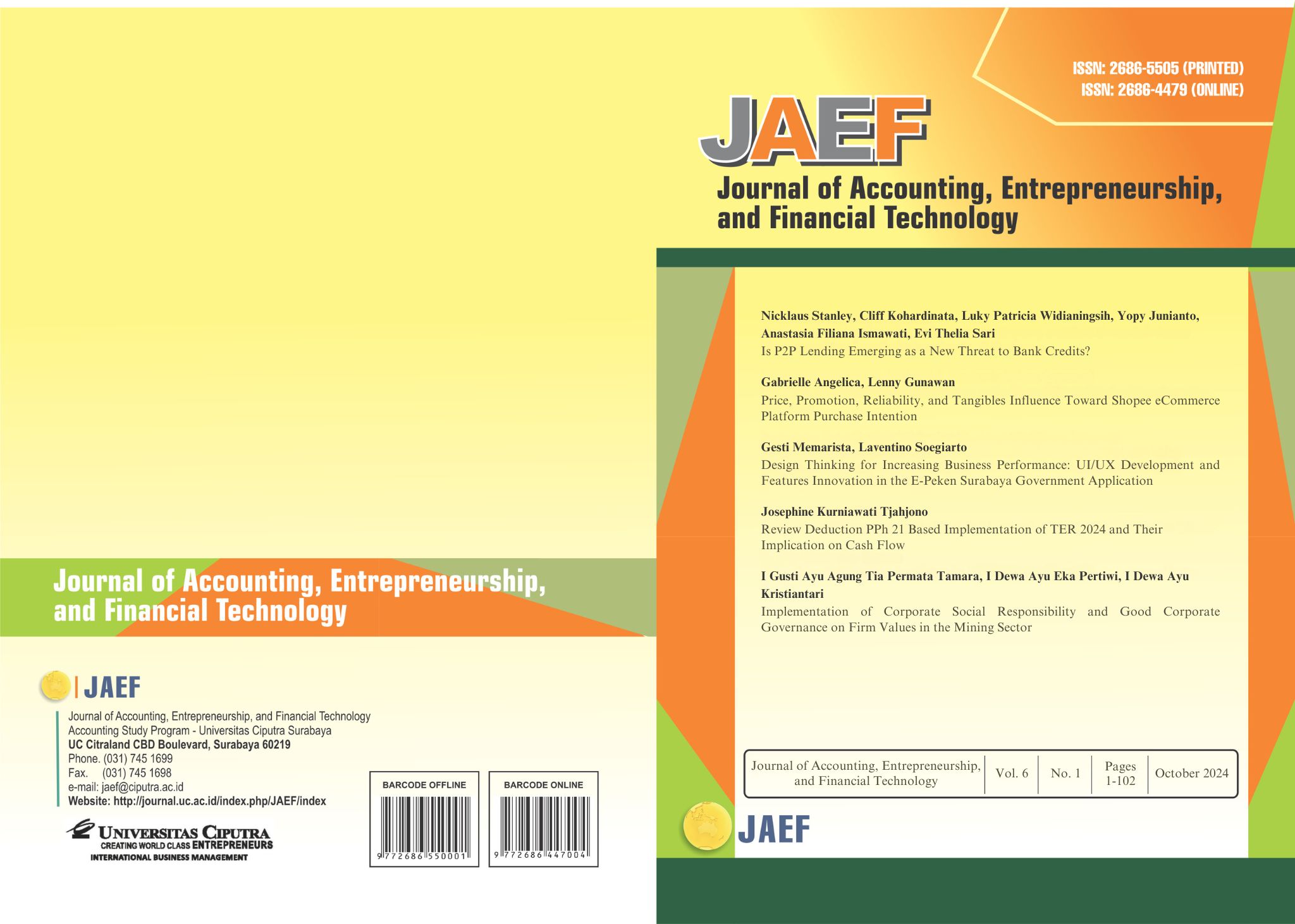
IS P2P LENDING EMERGING AS A NEW THREAT TO BANK CREDITS?
Article Sidebar
Main Article Content
Abstract
The emergence of fintech is one of the newest business models in the financial sector. One of fintech’s service products is P2P platforms. Since the P2P platform first emerged, it has experienced drastic and significant changes. The banking sector, which distributes credits to consumers in the form of working capital credit, consumption credit, and investment credit, has a major contribution to Indonesia’s economic growth and must be cautious of the significant growth of P2P lending. This empirical study aims to examine the impact of P2P lending on working capital credit, consumption credit, and investment credit in Indonesia throughout 2022. This empirical study uses secondary data obtained from the Financial Services Authority (OJK) website from January 2022 to December 2022
which is then analyzed using panel data regression. The results of this empirical study show that P2P lending does not significantly affect working capital credit and investment credit, but instead has a significant positive effect on consumption credit.
Article Details

This work is licensed under a Creative Commons Attribution-ShareAlike 4.0 International License.
References
Anggari, N. L. S., & Dana, I. M. (2020). The Effect of Capital Adequacy Ratio, Third Party Funds, Loan to Deposit Ratio, Bank Size on Profitability in Banking Companies on IDX. American Journal of Humanities and Social Sciences Research, 4(12), 334–338.
Badan Pusat Statistik. (2023, January 2). Perkembangan Indeks Harga Perdagangan Besar. Berita Resmi Statistik. Retrieved 7 September, 2023, from: https://www.bps.go.id/pressrelease/2023/01/02/2003/pada-desember-2022--perubahan-indeks-harga-perdagangan-besar--ihpb--umum-nasional-tahun-ke-tahun-sebesar-5-78-persen.html
Chugh, S. K. (2014). Chapter 1 Microeconomics of Consumer Theory. Retrieved 18 June, 2023, from: http://skchugh.com/images/Chapter1.pdf
Cintiya, C., & Riswan, R. (2022). Pengaruh Kinerja Keuangan Terhadap Penyaluran Kredit. SIBATIK JOURNAL: Jurnal Ilmiah Bidang Sosial, Ekonomi, Budaya, Teknologi, Dan Pendidikan, 1(10), 1931–1938.
Cole, R. A., Cumming, D. J., & Taylor, J. R. (2019). Does FinTech Compete With or Complement Bank Finance? SSRN, 1-38
Elsaid, H. M. (2021). A Review of Literature Directions Regarding The Impact of Fintech Firms on The Banking Industry. Qualitative Research in Financial Markets, 15(5), 1-19.
Eng, T. S. (2013). Pengaruh NIM, BOPO, LDR, NPL & CAR Terhadap ROA Bank Internasional dan Bank Nasional Go Public Periode 2007-2011. Jurnal Dinamika Manajemen, 1(3), 153–167.
Gujarati, D. N., & Porter, D. C. (2008). Basic Econometrics (5th ed.). McGraw-Hill/Irwin.
Hasibuan, U. S. E., Rorong, I. P. F., & Maramis, M. Th. B. (2022). Efektivitas Tabungan, Giro dan Deposito Sebelum dan Saat Pandemi COVID-19 pada PT. Bank Rakyat Indonesia. Jurnal Berkala Ilmiah Efisiensi, 22(4), 136–147.
Imoughele, L. T., & Ismaila, M. (2013). Commercial Bank Credit Accessibility and Sectoral Output Performance in a Deregulated Financial Market Economy: Empirical Evidence from Nigeria Imoughele 1. Journal of Finance and Bank Management, 1(2), 36–59.
Kohardinata, C., Suhardianto, N., & Tjahjadi, B. (2020). Peer-to-Peer Lending Platform: From Substitution to Complementary for Rural Banks. Business: Theory and Practice, 21(2), 713–722.
Kohardinata, C., & Widianingsih, L. P. (2023). Pertumbuhan Pinjaman Peer-to-Peer (P2P) Terhadap Pertumbuhan Kredit Modal Kerja, Investasi, dan Konsumsi: Disruptif pada Perbankan di Indonesia-kah? Jurnal E-Bis, 7(1), 1–13.
Le, T. D. Q., Ho, T. H., Nguyen, D. T., & Ngo, T. (2021). Fintech Credit and Bank Efficiency: International Evidence. International Journal of Financial Studies, 9(3), 44, 1-16.
Levin, J., & Milgrom, P. (2004). Consumer Theory. Stanford University. Retrieved 18 June, 2023, from: https://web.stanford.edu/~jdlevin/Econ%20202/Consumer%20Theory.pdf
Meilanti, M., & Fitria, L. (2021). Strategi Pemasaran Produk Tabungan, Giro dan Deposito PT. Bank Sinarmas Tbk Cabang Dumai. Jurnal Ilmiah Ekonomi Dan Pajak (EJAK), 1(1), 30–34.
Nurjannah, & Nurhayati. (2017). Pengaruh Penyaluran Kredit Investasi, Kredit Modal Kerja dan Kredit Konsumtif Terhadap Pertumbuhan Ekonomi Indonesia. Jurnal Samudra Ekonomi Dan Bisnis, 8(1), 590–601.
Otoritas Jasa Keuangan. (2022). Statistik Fintech Lending. Otoritas Jasa Keuangan. Retrieved 3 September, 2023, from: https://ojk.go.id/id/kanal/iknb/data-dan-statistik/fintech/Pages/Statistik-Fintech-Lending-Periode-Desember-2022.aspx
Rahmayanti, I. D. (2024). Pengaruh Dana Pihak Ketiga (TPF), Non Performing Loan (NPL) dan Loan to Deposit Ratio (LDR) Terhadap Penyaluran Kredit (Pada PT. Bank Perkreditan Rakyat di Kabupaten Bogor Periode 2018-2022). Innovative: Journal of Social Science Research, 4(3), 10678–10692.
Rodríguez, R. C., & Chávez, A. T. (2023). The Importance of Bank Credit For The Economic Activity in Mexico: A Manufacturing Sector Analysis. Ensayos Revista de Economía, 42(1), 83–120.
Sabar, W., & Kuslin. (2018). Menakar Dampak Suku Bunga, Nilai Tukar, dan Inflasi Terhadap Permintaan Kredit Konsumsi. AL-MASHRAFIYAH: Jurnal Ekonomi, Keuangan, Dan Perbankan Syariah, 2(2), 77–91.
Sari, L., Nurfazira, N., & Septiano, R. (2021). Pengaruh Non Performing Loan, Suku Bunga Kredit, dan Modal Bank Terhadap Penyaluran Kredit Pada Perusahaan Perbankan LQ 45. Jurnal Ekonomi Manajemen Sistem Informasi, 2(6), 702–713.
Serrano-Cinca, C., Gutiérrez-Nieto, B., & López-Palacios, L. (2015). Determinants of Default in P2P Lending. PLoS ONE, 10(10), 1-22.
Shahzad, A., Zahrullail, N., Akbar, A., Mohelska, H., & Hussain, A. (2022). COVID-19’s Impact on Fintech Adoption: Behavioral Intention to Use the Financial Portal. Journal of Risk and Financial Management, 15(10), 1-18.
Shin, Y. J., & Choi, Y. (2019). Feasibility of the Fintech Industry as an Innovation Platform for Sustainable Economic Growth in Korea. Sustainability (Switzerland), 11(19), 1-21.
Stanley, N., Caroline Hanjaya, V., & Kohardinata, C. (2024). Platform P2P dan Perbankan: Akses Keuangan Bagi Provinsi-Provinsi Tertinggal. Jurnal Cendekia Ilmiah, 3(4), 1396–1404.
Sugiharti, H. A., & Diana, N. (2022). Effect of TPF and NPL on Credit Distribution at Private Bank Period 2016-2020. The Accounting Journal of Binaniaga, 7(2), 275–286.
Tangngisalu, J., Hasanuddin, R., Hala, Y., Nurlina, N., & Syahrul, S. (2020). Effect of CAR and NPL on ROA: Empirical study in Indonesia Banks. Journal of Asian Finance, Economics and Business, 7(6), 9–18.
Taujanskaitė, K., & Kuizinaitė, J. (2022). Development of Fintech Business in Lithuania: Driving Factors and Future Scenarios. Business, Management and Economics Engineering, 20(1), 96–118.
Wang, D., Peng, K., Tang, K., & Wu, Y. (2022). Does Fintech Development Enhance Corporate ESG Performance? Evidence from an Emerging Market. Sustainability (Switzerland), 14(24), 1-21.
Wei, X., Gotoh, J. Y., & Uryasev, S. (2018). Peer-to-Peer Lending: Classification in the Loan Application Process. Risks, 6(4), 1-17.
Yang, X., Fan, W., & Yang, S. (2020). Identifying the Influencing Factors on Investors’ Investment Behavior: An Empirical Study Focusing on the Chinese P2P Lending Market. Sustainability (Switzerland), 12(13), 1-22.
Yudaruddin, R. (2023). Financial Technology and Performance in Islamic and Conventional Banks. Journal of Islamic Accounting and Business Research, 14(1), 100–116.
Yudhistira, A. W., & Sugiastuti, R. H. (2023). Analisis Pengaruh Inflasi, Suku Bunga BI-7DRR, Dana Pihak Ketiga (TPF) dan Non Performing Loan (NPL) Terhadap Penyaluran Kredit (Studi Pada Bank Umum KBMI 3 dan 4 yang Terdaftar di BEI Periode 2019-2022). JEMBA: Jurnal Ekonomi, Manajemen, Bisnis Dan Akuntansi, 2(4), 417–430.