



REVIVING THOUGHTS: IN SEARCH OF SUWONDO’S RELEVANCE IN MODERN CONTEXT
Article Sidebar
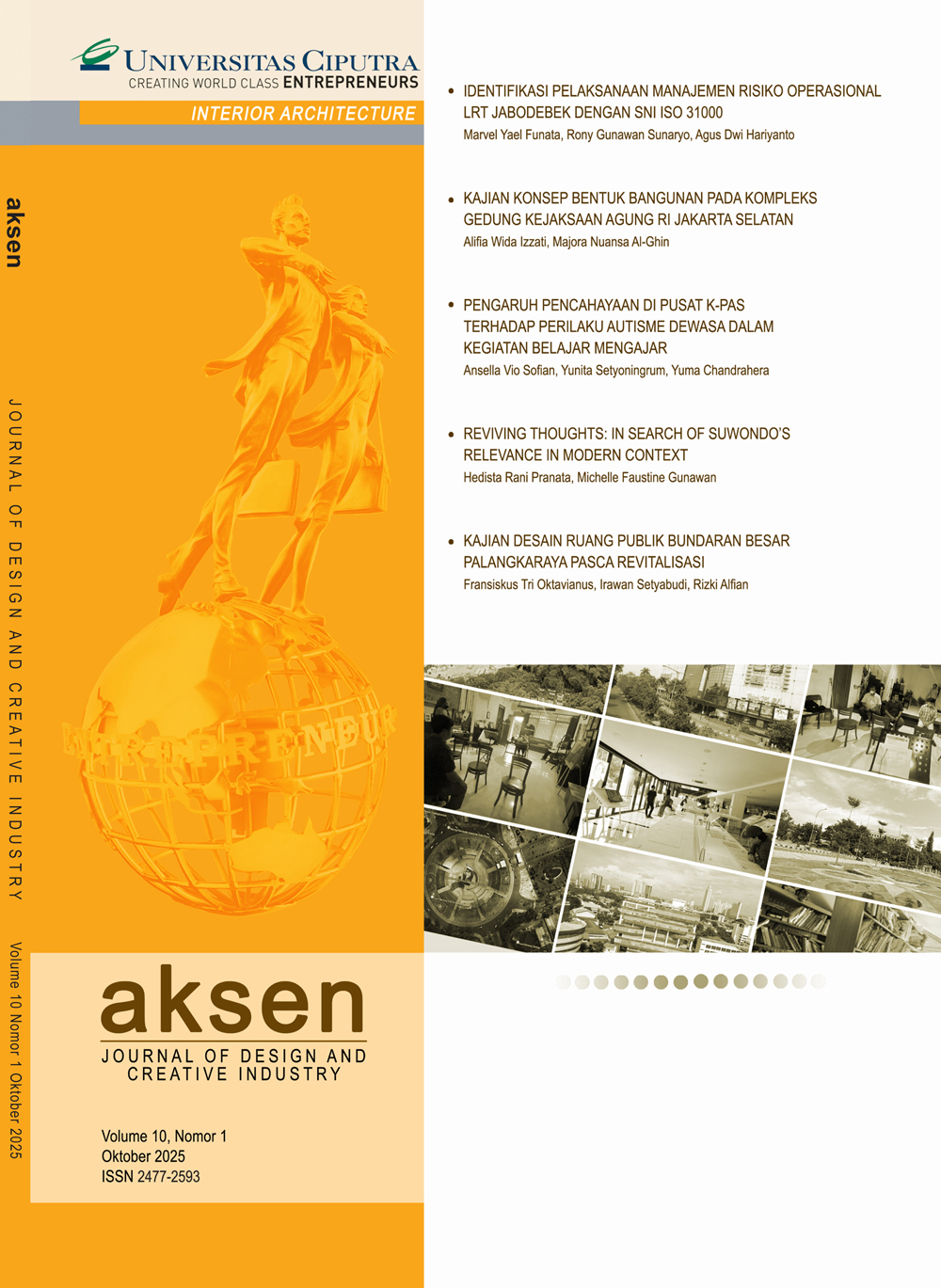
Main Article Content
Abstract
Suwondo Bismo Sutedjo is a name that resonates deeply within the Indonesian architectural community. As an academic, architect, and thought leader, his work from the 1960s to 1990s reflects a strong commitment to both architectural practice and the socio-cultural responsibilities that surround it. His legacy lives on not only through built projects but also through a rich body of writings on architecture, urban planning, and education. In January 2024, a significant portion of Suwondo’s archives—comprising articles, photographs, sketches, and personal notes—was acquired by the Museum of Indonesian Architecture. This acquisition provided an opportunity to revisit his ideas through a contemporary lens. This article explores the relevance of Suwondo’s thoughts today through creative curatorial practices that challenge traditional archival exhibitions. A central aim of the project was to dissolve the conventional distance between archive and audience. Visitors were encouraged to interact directly with reproduced archived—turning passive viewing into active engagement. Through workshops and open-ended interpretation of the exhibition, the curatorial process invited public participation in reactivating Suwondo’s legacy and relevance in modern context. In doing so, it demonstrates how archives can become sites of dialogue, where historical architectural thought resonates within present-day contexts.
Article Details

This work is licensed under a Creative Commons Attribution-ShareAlike 4.0 International License.

This work is licensed under a Creative Commons Attribution-ShareAlike 4.0 International License.
References
Armstrong, A.R.E. (2006) ‘Architectural Archives/Archiving Architecture: The Digital ERA’, Art Documentation: Journal of the Art Libraries Society of North America, 25(2), pp. 12–17. Available at: https://doi.org/10.1086/adx.25.2.27949434.
Azoulay, A.A. (2019) Potential History: Unlearning Imperialism, Potential History: Unlearning Imperialism. London: Verso.
Bal, M. (2012) ‘Curatorial Acts’, Journal of Curatorial Studies, 1(2), pp. 179–192. Available at: https://doi.org/10.1386/jcs.1.2.179_1.
Banks, M. and Vokes, R. (2010) ‘Introduction: Anthropology, photography and the archive’, History and Anthropology, 21(4), pp. 337–349. Available at: https://doi.org/10.1080/02757206.2010.522375.
Burns, K. (2013) ‘Archive Stories / Symptomatic Histories : The Commemoration of Australian Frontier Space at Purrumbete , 1840 – 1902’, Architectural Theory Review: Architecture, Evidence, and Evidentiality, 18(1).
Daston, L. (2017) Science in the Archives: Pasts, Presents, Futures. Chicago: University of Chicago Press.
Figueiredo, R. (2021) ‘Curatorial Practices: a call for architectural critical action’, Critique d’art, (57), pp. 67–81. Available at: https://doi.org/10.4000/critiquedart.85180.
Hobbs, C. (2001) ‘The character of personal archives: Reflections on the value of records of individuals’, Archivaria, 52(1), pp. 126–135.
International Council on Archives (2020) General International Standard Archival Description. 2nd edn. Ottawa. Available at: https://doi.org/10.1081/e-elis4-120044715.
Kaethler, M. (2019) ‘Curating creative communities of practice: the role of ambiguity’, Journal of Organization Design, 8(1). Available at: https://doi.org/10.1186/s41469-019-0051-z.
Yaneva, A. (2020) Crafting History, Crafting History. Available at: https://doi.org/10.1515/9781501751837.
Zardini, M. (2005) Sense of the City: An Alternate Approach to Urbanism. Montréal: Lars Müller Publishers.